

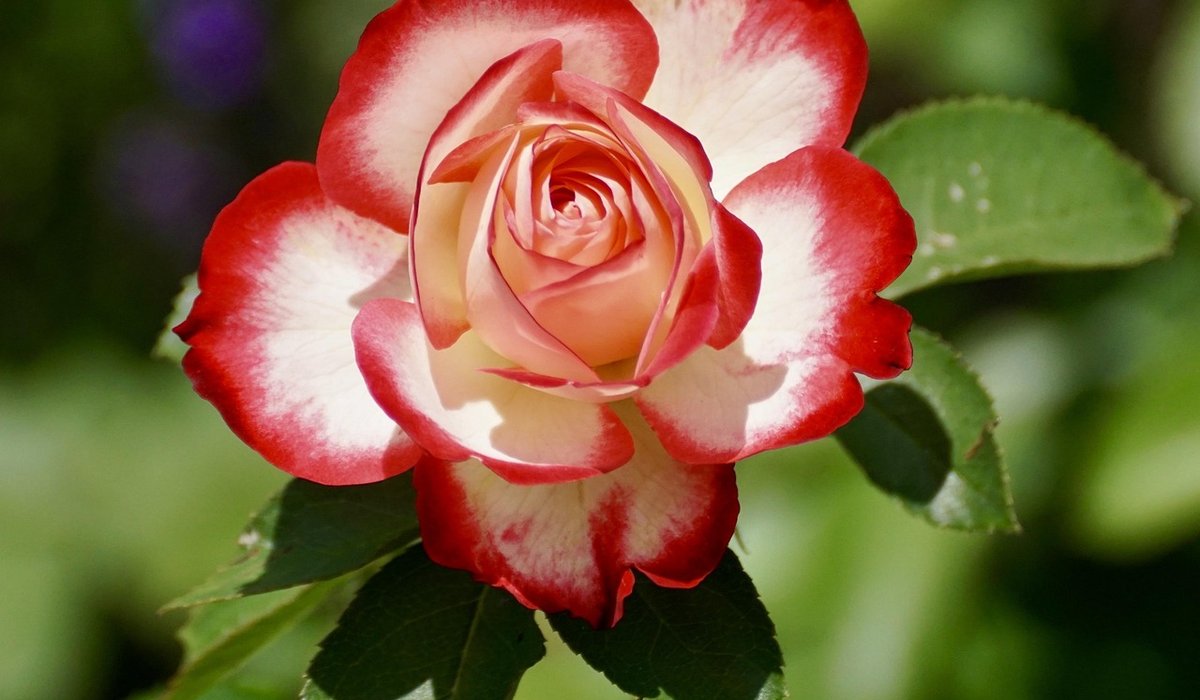
Climbing roses are among the most rewarding plants you can grow against a cottage wall, but they are also among the most misunderstood. Unlike shrub roses, which are pruned to build a sturdy framework of stems, climbers are trained to cover a surface and flower along long, flexible growth. Get the pruning right and you will be rewarded with a wall that is smothered in bloom from early summer onwards. Get it wrong and you will be left with a tangle of woody stems, a few flowers at the very top, and a frustrating job every year.
The good news is that the principles are straightforward. Climbing roses flower best on young wood that has been trained roughly horizontal, because sap travels more slowly along a flat stem and triggers flower buds along its length rather than pushing all the energy into a single upward shoot. Once you understand that, every cut you make starts to make sense.
Timing matters more than most gardeners realise. The right moment depends on whether your rose flowers once or repeatedly.
If you are unsure which type you have, watch it for a season. A rose that produces one magnificent flush and then nothing is a once-flowerer. One that keeps producing smaller waves of bloom into autumn is a repeat-flowerer.
Pruning and training are really one job. Before you make a single cut, take a step back and look at the shape of the plant.
Untie the stems from their supports and gently lay them out so you can see what you have. Then decide on your framework: usually three to five strong main stems, spaced evenly across the wall or pergola, with the oldest wood removed to make room for new growth. The aim is a fan of stems rather than a bundle of vertical ones.
Airflow is not just about tidy walls. Good circulation discourages blackspot, powdery mildew and other fungal problems that thrive in still, crowded conditions.
With your framework in mind, work through the plant methodically. Sharp, clean secateurs and a pair of sturdy gloves are essential.
If you are dealing with a badly overgrown rose that has not been touched for years, do not try to do everything at once. Spread the renovation over two or three winters, removing roughly a third of the old wood each time.
Pruning is only half the story. A climbing rose that is regularly fed and mulched will produce stronger growth and more flowers than one left to fend for itself.
One of the joys of a small garden is that every plant has to earn its place, and a well-trained climbing rose does exactly that. It takes up almost no ground space, softens hard walls and fences, and gives you flowers at eye level where you can actually enjoy them. In a courtyard or tiny cottage plot, a single climbing rose trained across a south-facing wall can become the focal point of the entire garden.
Keep the framework open and airy, tie in new growth each year, and your rose will reward you season after season. There is no secret beyond patience and a sharp pair of secateurs.

Quaintbower An honest, everyday look at the things that make life a little better — with advice you can actually use.

Quaintbower An honest, everyday look at the things that make life a little better — with advice you can actually use.

Discreetly placed mirrors can bounce light and blur boundaries. Choose weatherproof frames and position them to reflect greenery, not neighbours.

Comments
ALina Kelian
19th May 2018 ReplyQuaintbower An honest, everyday look at the things that make life a little better — with advice you can actually use. ullamco laboris nisi ut aliquip ex ea commodo consequat.
Rlex Kelian
19th May 2018 ReplyQuaintbower We spend our time finding what works so you don't have to, and sharing exactly what made the difference. ullamco laboris nisi ut aliquip commodo.
Roboto Alex
21th May 2018 ReplyQuaintbower No rushing, no fuss — just thoughtful notes and practical help, written by people who care. ullamco laboris nisi ut aliquip ex ea commodo consequat.